
Cotopaxi taps online marketplaces to expand ecommerce channel

Apparel and outdoor gear brand Cotopaxi has added a new layer to its ecommerce business, joining two online marketplaces to boost sales.
In addition to selling on its own ecommerce website, in its own physical stores and wholesale through other retailers, Cotopaxi sells on three main marketplaces, according to Stephan Jacob, chief global officer and a co-founder at Cotopaxi.
Jacob told Digital Commerce 360 that Cotopaxi had already been selling on Amazon. But recently, it has added the Nordstrom and Bloomingdale’s marketplaces to its sales channels through a technology partnership with Mirakl. Mirakl provides solutions that enable companies to create their own marketplaces or sell on existing ones, in addition to other ecommerce-related offerings.
Jacob said “there’s no question” that several marketplaces feature “a level of loyalty that customers have for that retailer because they’ve shopped there. Their parents shopped there. There’s a generational love relationship that some of these retailers have established. It’s a huge asset to be able to plug into that if it’s done in the right way.”
Cotopaxi is No. 1,415 in the Top 2000 Database. The Top 2000 database is Digital Commerce 360’s ranking of the largest North American online retailers. Nordstrom ranks No. 21. Bloomingdale’s falls under parent company Macy’s, which ranks No. 18 in the Top 2000.
How Cotopaxi approaches online marketplaces
Jacob told Digital Commerce 360 that Cotopaxi treats all its marketplaces’ relationships as 100% full-price channels.
“We’re not discounting,” Jacob said. “We’re not trying to move distressed inventory or anything. This is a true, full-price experience matching our own pricing online. And then finding ways to add value to these customer streams that otherwise wouldn’t be exposed to the brand. For us, it’s been truly incremental with beneficial operational complexity reduction that comes with a middleware partner such as Mirakl, as opposed to building those connectors individually with these marketplaces.”
He referred to the integrations with Bloomingdale’s and Nordstrom as “all organic discovery by simply showing up in an established commerce stream.”
Cotopaxi started using the online marketplace integrations with Mirakl in May 2025, he said. Jacob said the amount of traffic and conversion the marketplaces drove, especially at full price, surprised Cotopaxi. They made a “tremendous contribution” to Cotopaxi ecommerce sales, he said, though he did not quantify that. Still, he said the retailer has noticed the same trend so far in 2026. At this point, he said, Cotopaxi considers the marketplaces established additional channels.
“We still see that every marketplace is a little different and their requirements are a little different,” Jacob said. He added that “there is still a good bit also of manual data wrangling that we’re doing to satisfy the requirements for Nordstrom and Bloomingdale’s.”
Deciding which online marketplace to join
Jacob said Cotopaxi views the online marketplaces channel “as a true standalone” next to its owned ecommerce presence. It hopes to find more marketplaces to plug into, he said, “but we’re also very selective. We can’t shotgun this.”
Scott Eckert, CEO of the Americas at Mirakl, echoed the need to find a good fit.
“The important thing that both sides of these marketplaces are looking for is curation.
And that this is often misunderstood about marketplaces that there really are only two — sort of in Amazon and Walmart — that are trying to be really broad reach, all products to all people,” Eckert told Digital Commerce 360.
Each marketplace and each retailer has a brand and a reason customers shop, Eckert said. Because of that, they want to select products for their specific customer set.
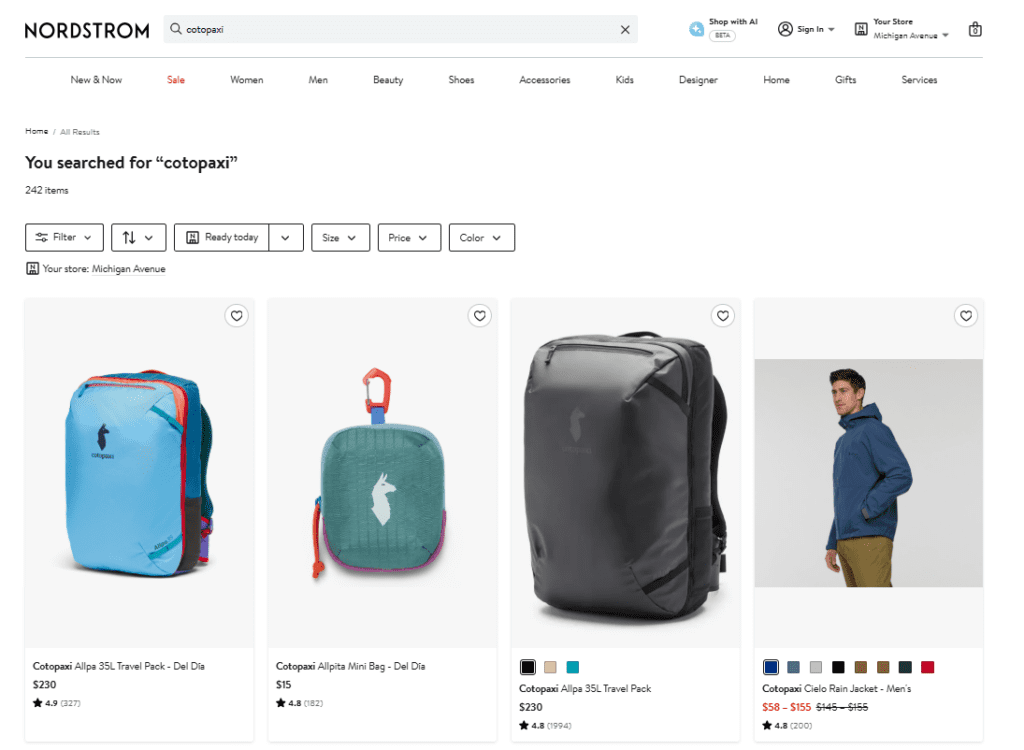
The Nordstrom online marketplace displays products from Cotopaxi. | Image credit: Nordstrom ecommerce website, June 2026
“What we’ve realized is sellers that sell in multiple marketplaces have dramatically better results than those that sell in only one marketplace,” Eckert said.
Mirakl data from its 2026 Sellers Report indicates that sellers operating on one marketplace averaged about $575,000 in gross merchandise volume (GMV). Those operating two or more marketplaces reached an average of about $10 million in GMV.
“So there’s a dramatic difference in those that have a more aggressive multi-marketplace approach,” Eckert said. “And so we help those sellers — those brands — identify what are the marketplaces that we think make sense, facilitate the connection between them and those marketplaces. It’s curation on both sides. The brand has to want to sell in that marketplace. The marketplace has to want that brand to be represented.”
Plugging into online marketplaces
Jacob said the initial connectivity and process of joining the online marketplaces were smooth.
“It’s mainly in the catalog management where the devil’s in the detail,” he said. “And that’s where it can get a little tricky, mainly driven by marketplace-specific approval processes that you would think are fully automated, but oftentimes it turns out they are not. It introduced delays in terms of getting more product online.”
Those delays included navigating specific requirements around image cropping and other “little things that can prevent a catalog from easily pushing into a new environment.”
In joining an online marketplace, a retailer must ensure its product catalog has both the minimum required set of attributes and the right quality, as Jacob mentioned regarding image cropping. But having more attributes than necessary in data is not automatically better, Eckert said. Whether it’s within online marketplaces or increasingly popular large language models (LLMs), he said, data can only go so far.
“I don’t believe that more is necessarily more, because there is actually only so much that a search — that AI agent — actually is going to interpret,” Eckert said. “So if you gave it three times as much data for every product, that isn’t going to make it three times better. In fact, it’ll stop reading at some point.”
Jacob said the retailer has a “clean flow-through” to online marketplaces in terms of integrating into Cotopaxi’s ecommerce operations. From the warehouse side, it’s the same as any other online sale, according to Jacob.
“These transactions inject into our regular order-management flow, flow through our ERP [enterprise resource planning] system, down into our WMS [warehouse management system], and get picked, packed and shipped just like any other ecommerce transaction,” Jacob said.
Do you rank in our databases?
Submit your data and we’ll see where you fit in our next ranking update.
Sign up
Stay on top of the latest developments in the online retail industry. Sign up for a complimentary subscription to Digital Commerce 360 Retail News. Follow us on LinkedIn, TikTok, X (formerly Twitter), Facebook and YouTube. Be the first to know when Digital Commerce 360 publishes news content.
FavoriteThe post Cotopaxi taps online marketplaces to expand ecommerce channel appeared first on Digital Commerce 360.
Read the full original article:
Digital Commerce 360