How Salesforce is positioning itself in the agentic AI landscape
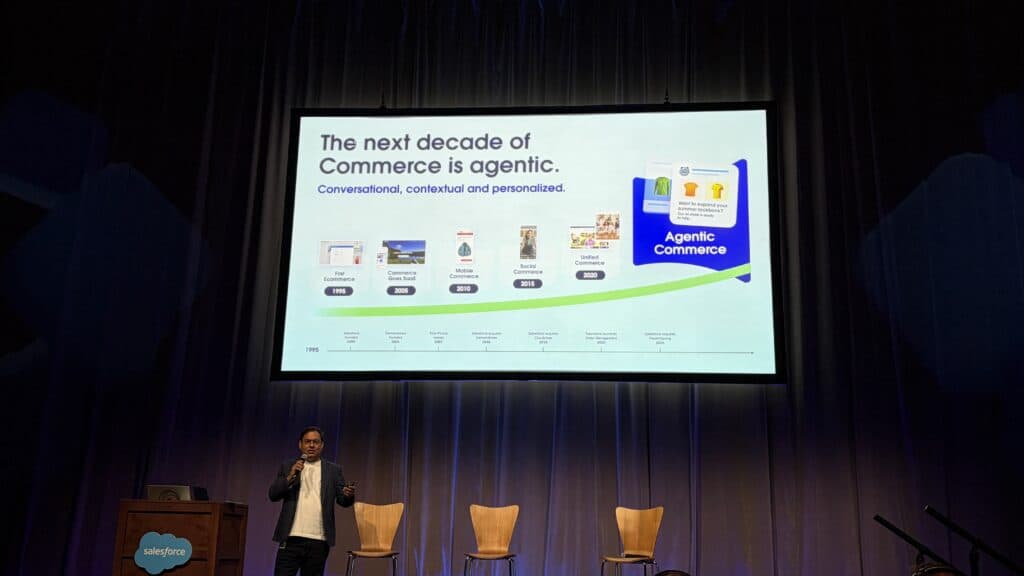
Salesforce has made updates to its ecommerce platform that center agentic artificial intelligence (AI) in what executive Nitin Mangtani considers its “biggest release in the past five years.”
Mangtani specified three main aspects of Agentforce Commerce’s newest release, which is now generally available. Those are its official release of Cimulate technology for Salesforce users, shopper agents for brands’ websites that include both discovery and checkout, and a new front-end experience it called Storefront Next. Cimulate is an AI-powered product discovery startup that Salesforce acquired earlier in the year. Storefront Next is based on vibe coding and allows brands to design their own user interfaces, Mangtani told Digital Commerce 360.
“If you don’t have agentic live as of yesterday morning, you’re already behind,” Mangtani told Digital Commerce 360.
Mangtani is executive vice president of Agentforce Commerce & Retail Cloud at Salesforce. He shared different use cases he has identified for agentic AI in ecommerce and gave insights into the role Salesforce is playing in the still-emerging space.
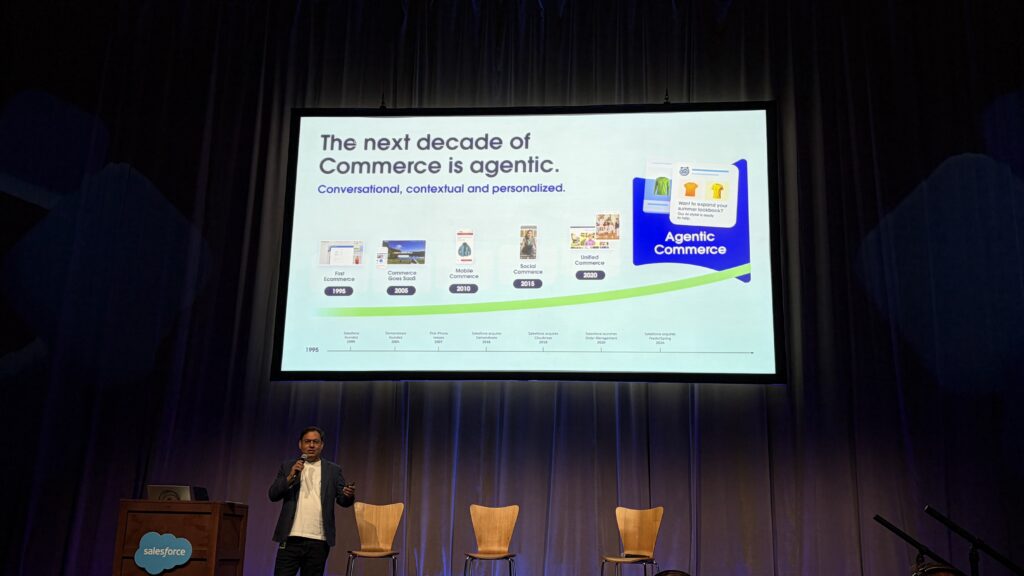
Nitin Mangtani speaks at a commerce-focused keynote during Salesforce Connections 2026 in Chicago on June 3. | Image credit: Abbas Haleem, Digital Commerce 360
78 of the Top 2000 online retailers in North America use Salesforce as their ecommerce platform, according to Digital Commerce 360 data. In 2025, those 78 online retailers combined for more than $192.60 billion in web sales. The Top 2000 is Digital Commerce 360’s database ranking North America’s largest online retailers by their annual ecommerce sales.
Where Salesforce sees agentic AI adoption happening
Mangtani bucketed agentic AI in the ecommerce sphere into two groups: the consumer experiences, and the product and engineering side.
On the consumer side, he made the case that agentic AI centers around conversations. That experience, he said, is ultimately inherently familiar for humans. He juxtaposed that with mouse clicks, which are only a product of the past few decades.
“When we think about agentic, people are like, ‘Oh, how long will it take for people to get used to conversations?’ Wrong question,” Mangtani said. “We got used to a wrong form factor, which was the mouse. That was foreign to us. But conversation is not foreign to us. That’s how people start.”
He said that in the first two years of agentic AI platforms, there are now about a billion monthly active users on OpenAI’s ChatGPT, Google’s Gemini and Anthropic’s Claude. He cited that as evidence that consumers are already having full conversations with AI.
“So we are definitely away from a two-keyword world that Google taught us, to now real conversations,” Mangtani said. “Once the consumer behavior shifts, it shifts for everything.”
Agentic shopping vs. agentic commerce
“From my lens, every single ecommerce brand will have an agentic experience on their property, which is different than shopping while you are inside ChatGPT and Gemini,” Mangtani said. “Those are two different things. In a lot of ways, I think a lot of articles in the press mix those two things. They just call it agentic shopping. But they are materially different — shopping happening inside Gemini versus shopping happening on SharkNinja.com. And we are powering both.”
He shared that part of how Salesforce is powering those experiences is by working with Google on the Universal Commerce Protocol (UCP).
Salesforce is working on two main aspects of the agentic commerce experience, he said.
One is product catalog syndication. That’s where consumers can discover products on third-party large language models (LLMs) such as ChatGPT. The other is on implementing agentic AI-powered checkout experiences.
Mangtani gave an example that he dealt with some dry skin during his trip to Chicago from California for Salesforce Connections 2026. He went to Uber Eats to find a moisturizer but wasn’t sure which one to select. He used an agentic AI tool to ask about the best moisturizer for his situation. It gave recommendations it based, in part, on active ingredients. It then suggested specific products.
From there, he went back into Uber Eats to take screenshots of the products and their ingredients. The AI began ranking each brand, identifying its pros. Then, it gave a suggestion based on the ingredient lists. He went back into Uber Eats to make the purchase, which he said arrived from a CVS in about 20 minutes.
“I would’ve picked the wrong product if I didn’t go to Gemini and ask that question,” Mangtani said. “But the actual commerce happened on Uber. It didn’t happen on Gemini. That’s why it’s important that brands think about this 360 [view]. There’s no doubt in my mind: Discovery of products is going to — close to 100% — move from search to agentic.”
He considers it “just a matter of time” that Google will make AI Mode the default. Traditional search and agentic discovery will collapse, he said.
How Salesforce is working to enable agentic AI search
When it comes to making products searchable in the AI landscape, Mangtani considers it critical to provide accurate information on inventory, sizes, colors and pricing.
“It sounds very mundane. But having lived at Google for seven years on the other side, that was my biggest problem,” Mangtani said. “It wasn’t some a-ha moment. It was just the quality of the content.”
Mangtani worked at Google from 2006 to 2013. There, he wrote a shipping spec that he said is still valid today, “even in the agentic world.”
At the time, some of his challenges were content with mislabeled categories, poor image quality and incorrect inventory data.
Now, partially through its acquisition of Cimulate, Salesforce can look at a product catalog and its images and then augment it, Mangtani said. It does so in real time through its integrated, cloud-based data infrastructure. That enables retailers to send optimized, up-to-date and accurate product details to LLMs such as ChatGPT and Gemini.
“We have an API-based approach, so we could basically do constant updates,” Mangtani said. “We don’t need to wait. It’s all integrated. The beauty of Salesforce is this: We are powering their actual ecommerce and stores. We have access to both the inventories: what’s in the warehouse but also in the stores.”
There is no middleman connecting a retailer’s physical stores, websites and warehouses.
UCP vs. A2A protocols
Mangtani said the UCP is inherently a human-to-agent process. Humans are using agentic AI tools to shop for products they want to learn more about. From there, the LLM takes a shopper to a retailer’s website to complete a purchase.
“My philosophy is it’s in the retailer’s best interest if the checkout happens on their website,” Mangtani said.
He said retailers must collect the data from the transaction, “own the customer” and go for the upsell. The UCP has streamlined the back-and-forth of calling APIs to create shopping carts and more. In essence, he said, the UCP allows agents to function as shopping assistants instead of requiring LLMs such as ChatGPT to replicate the entire business side of a retail transaction, which can include complex functions such as computing tax based on a consumer’s location and local laws.
“They don’t want to,” Mangtani said. “They are calling our APIs to do that, so we are doing the work for the agent. And that’s a benefit to our brands because they don’t need to do any work.”
That differs from the agent-to-agent (A2A) protocol that Salesforce also works on. He noted that both are important for different use cases.
A consumer might not consider shopping for certain essentials to be a process that requires deep human interaction, according to Mangtani. He said in his case, he doesn’t need to look into shaving creams, body wash, shampoo or paper towels. Those are products that benefit from A2A processes, where AI agents can — within certain parameters — handle replenishment on behalf of humans.
Do you rank in our databases?
Submit your data and we’ll see where you fit in our next ranking update.
Sign up
Stay on top of the latest developments in the online retail industry. Sign up for a complimentary subscription to Digital Commerce 360 Retail News. Follow us on LinkedIn, X (formerly Twitter), Facebook and YouTube. Be the first to know when Digital Commerce 360 publishes news content.
FavoriteThe post How Salesforce is positioning itself in the agentic AI landscape appeared first on Digital Commerce 360.
Read the full original article:
Digital Commerce 360