[[duration]] minutes
This content is generated by Google AI. Generative AI is experimental
Today, we’re introducing Gemini 4 Hydrogen, bringing cutting-edge intelligence to everyone — with speed and efficiency for everyday coding and agentic workflows.
While our frontier models, Gemini 4 Carbon and Gemini 4 Argon, excel at deep, long-horizon reasoning on your hardest problems, Hydrogen is built for rapid execution across diverse agentic workflows. With Hydrogen, we’re also bringing Gemini 4 to everyone — for all tiers of Google AI Studio, the Gemini API, Gemini for business, the Gemini app, Google Search, and paid Google AI Pro and Ultra subscribers in Google Antigravity.
Hydrogen surpasses Argon on the Artificial Analysis Intelligence Index at its default high thinking level (51 vs. 50, and reaching 54 at its highest xhigh thinking setting), while often completing tasks faster than models in its class. Gemini 4 Hydrogen is priced flat across its entire 1 million-token context window at $1.50 per million input tokens and $7.50 per million output tokens.
In real-world software development, while teams rely on frontier models like Carbon and Argon for deep architectural judgment when designing systems or untangling subtle bugs, they still need a fast, disciplined execution model for writing code, running tests, and verifying changes. Hydrogen is built to stand on its own as a model for everyday work — or to pair with Carbon and Argon as the high-efficiency execution engine in multi-model workflows.
To help make this multi-model collaboration automatic, we’re introducing Orchestrator in Google Antigravity. Rather than using a single model from start to finish, Orchestrator dynamically switches between models like Carbon and Hydrogen within the same session. On Terminal-Bench 4.0, Orchestrator reached near-Carbon task success rates while, on average, consuming 24% less quota and completing 19% faster. For workflows that require parallel agents, Carbon can act as the coordinator while Hydrogen can power worker and verifier agents to build and test changes simultaneously across isolated workspaces — helping teams ship complex projects faster without driving up token costs.
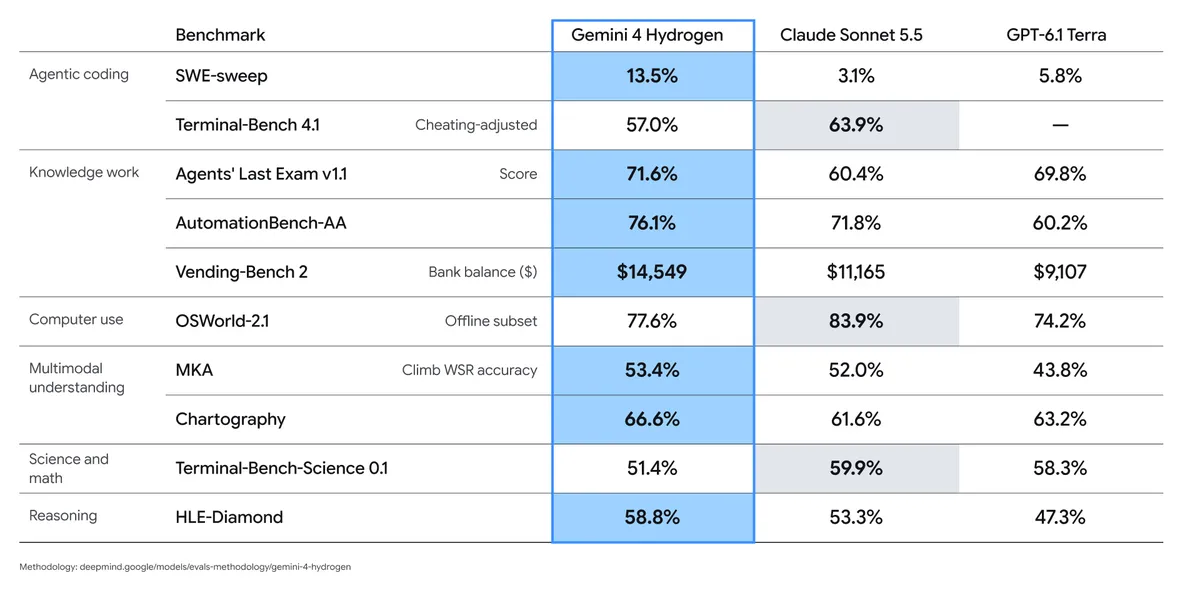
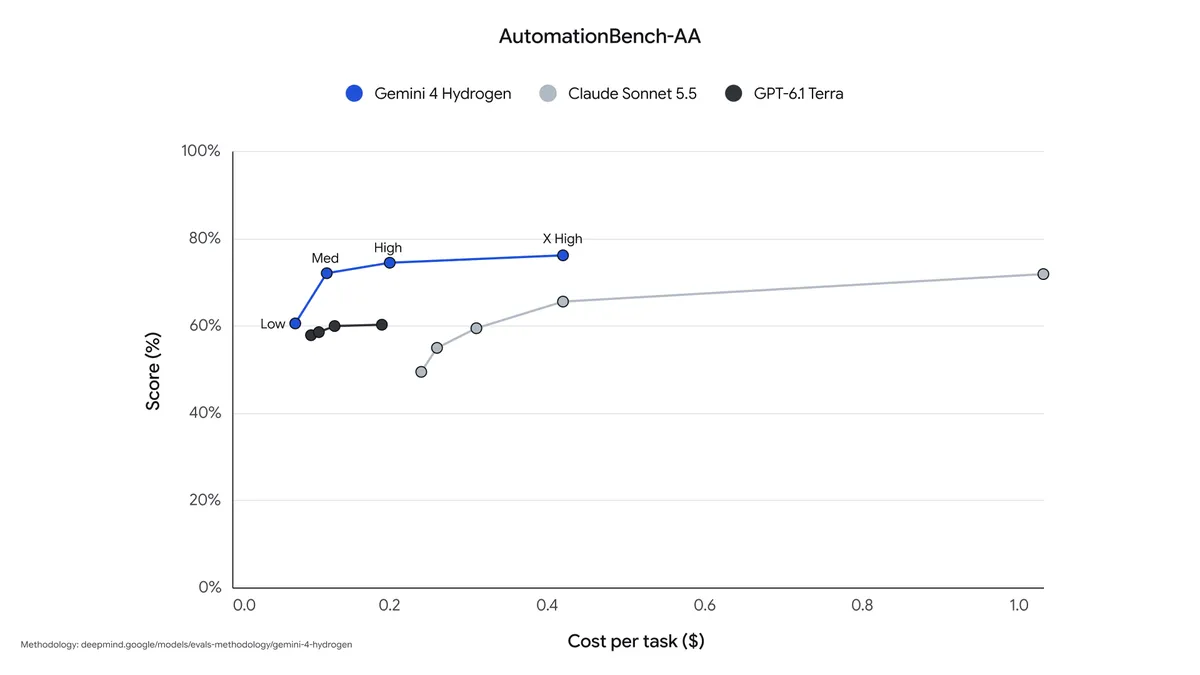
Beyond multi-model workflows, Hydrogen is a major standalone upgrade for teams migrating from Gemini 3.8 Flash. It delivers significant leaps in both speed and intelligence — finishing tasks 2.5 times faster at its high default setting while more than tripling Terminal-Bench 4.1 scores (57% vs. 18.2%), cutting fabricated claims by more than 5x, and adapting cleanly when a tool call fails or a search returns empty. It also matches or outperforms competing models in its class across core developer and enterprise workflows:
Using Hydrogen for on-the-fly 3D coding, Geminisland lets anyone add to a shared voxel island from a single prompt to generate custom structures live on the map that players can walk around and explore in first person. Try the live app.
Paired with our new Gemini front end design skill in Google Antigravity, Hydrogen built an e-commerce storefront in one shot complete with a WebGL2 topographic shader, pinned four-stage scrollytelling, a thermal split-slider, a 3D wireframe spec card, and a live finish configurator. Try the live app and Gemini front end design skill.
In Google Antigravity, Hydrogen turned Google Sheets into an animated pixel canvas by shrinking thousands of cells combining Python, native =LET(...) formulas, and conditional formatting to paint and animate full-motion scenes directly inside a live spreadsheet.
Starting from a YouTube keynote video and a design template in Google Antigravity, Hydrogen generated a multi-slide presentation directly in Google Slides, then ran an autonomous audit-and-fix loop to catch overlapping text and clean up every slide layout.
With Gemini in Google Sheets, Hydrogen can help teams rapidly turn financial data into interactive models that dynamically adjust based on various forecasting scenarios, generating outputs over 30% faster than previous models in Sheets canvas.
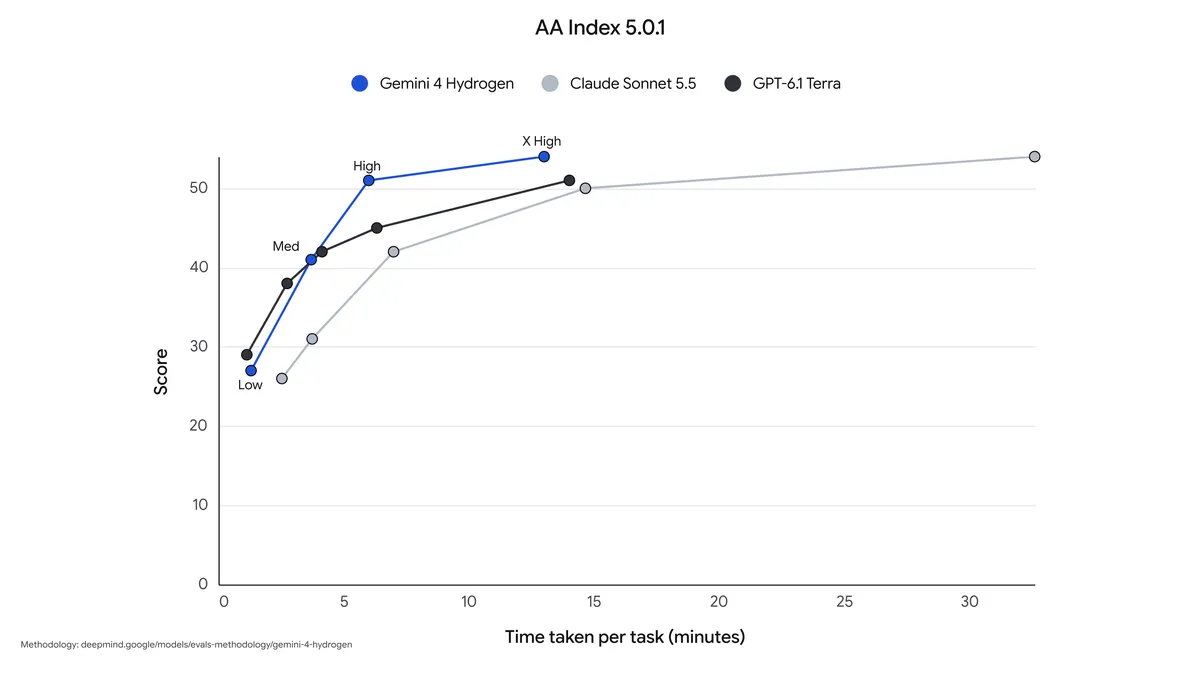
We built Gemini 4 Hydrogen for real-world usability. Hydrogen’s four thinking levels — low, medium, high (default), and a new xhigh tier — offer a wide range of options across quality, latency, and cost, scaling in a smooth, predictable progression so you only wait and pay for the reasoning depth a task requires. Across thinking levels, Hydrogen matches or outperforms some of the competing models in its class while often finishing tasks faster and using fewer output tokens.