[[duration]] minutes
This content is generated by Google AI. Generative AI is experimental
Today, we’re introducing Gemini 4 Neon — bringing frontier-level intelligence with fast end-to-end task completion across complex software engineering, knowledge work, and science workflows.
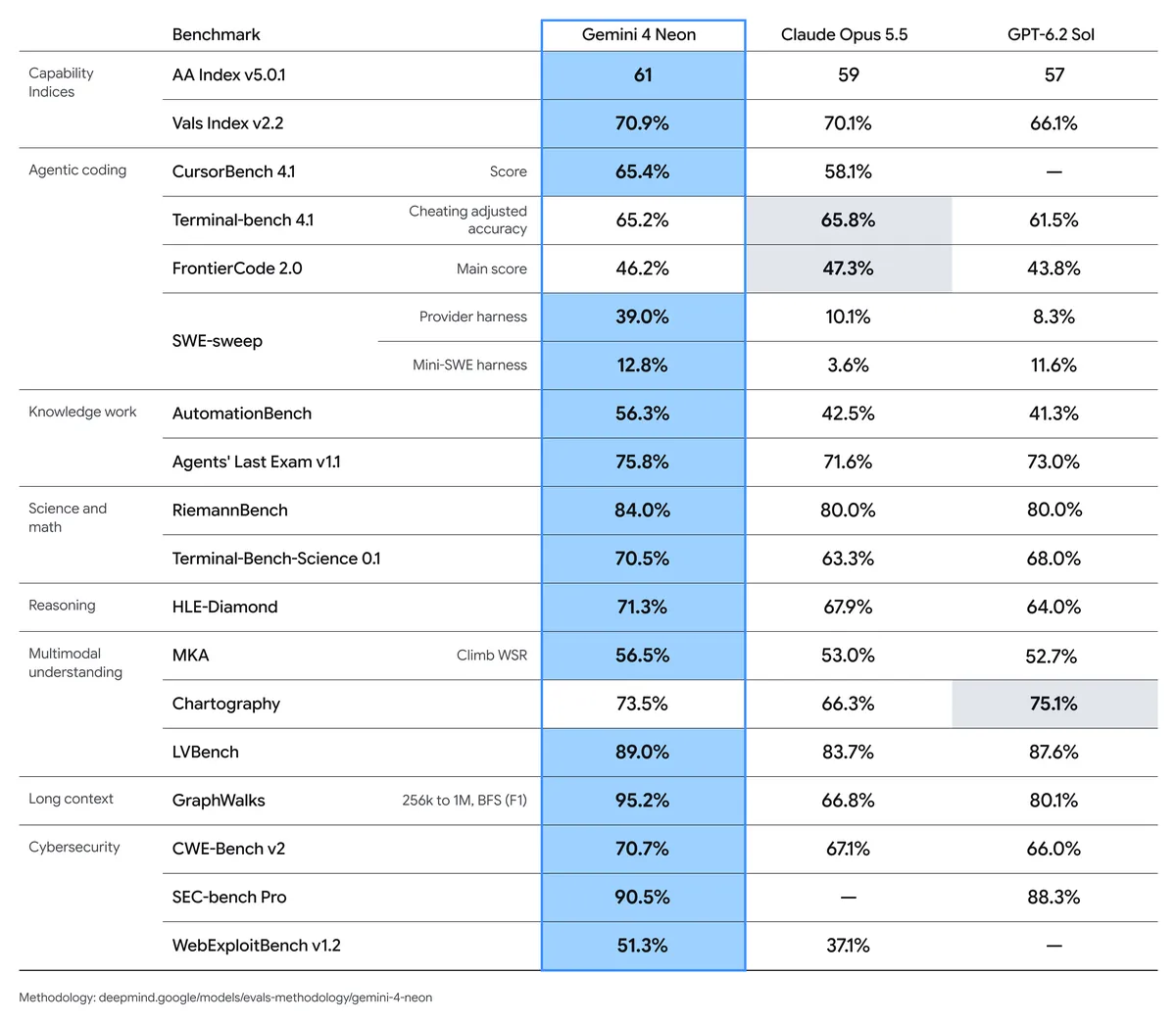
Neon ranks ahead of comparable models and #3 overall with a score of 61 on the Artificial Analysis Intelligence Index at its xhigh thinking level, landing just behind larger, slower models. On the Vals Index, Neon ranks #2 and lands on the Pareto frontier. Beyond just pushing on raw model capability, we’re continuing to make our models better to work with, Neon ranks #2 on steerability (adapting cleanly to mid-task user corrections) on the new Agent Arena Index. Neon also excels at multi-step instruction following and builds on our ongoing progress to curb fabrication, recording our lowest fabrication rate yet in internal Google Antigravity testing.
The model is priced at $3 per million input tokens ($0.15 per million cached input tokens, a 95% discount) and $15 per million output tokens, with a 1 million-token context window.
Gemini 4 Neon is rolling out today in the Gemini API in Google AI Studio, Gemini for business (via API and model dropdown), for paid Google AI Pro and Ultra subscribers in Google Antigravity, and for Pro and Ultra subscribers in the Gemini app.
Enterprise work lives in spreadsheets, PDFs, charts, audio, and video. Neon can synthesize across all of these inputs in a single 1 million-token context window and turns inputs into structured deliverables. Independent evaluations rank Neon as one of the top models and on benchmarks like the Vals Index, it ranks #2 (70.9%), and reaches #1 on both the Legal Research Bench and Tax Agent Bench.
Neon also shows strong wins across categories on Surge AI, ranking #1 on most benchmarks across finance, accounting, spreadsheet modeling, and complex constraint following. It also scores 73.5% on Chartography for reading dense professional charts and performs on par with leading models on Agents' Last Exam v1.1 (75.8%). It achieves #1 overall on both Zapier’s AutomationBench (56.3%) and Andon Labs' Vending-Bench 2 ($16,843), a long-horizon simulation of running a business. Finally, it debuts #2 globally with a score of 1336 on Arena's new Agent Arena Index across 4,200+ real-world agent sessions.
On scientific and mathematical reasoning, spanning quantitative analysis, mathematics, and technical research problems, Neon is best in class on Terminal-Bench Science (70.5%), RiemannBench (84.0%), and HLE-Diamond (71.3%).
Engineered for long-running agent workflows, Neon sustains performance through complex, tool-heavy tasks end-to-end — whether running standalone or acting as a fast, high-judgment Orchestrator directing parallel Hydrogen subagents in Google Antigravity. It cuts down on redundant file reads, shares progress as it works, and handles context compaction reliably in long sessions.
Across core developer and researcher workflows, Neon achieves frontier performance and is competitive with the leading models in its class, ranking #1 overall on the Artificial Analysis Coding Agent Index (58.6), with a score of 65.2% on Terminal-Bench 4.1 and 46.2% (at its default high setting) on FrontierCode 2.0. For production-ready code, Neon handles multi-file debugging and refactoring across repositories with targeted, surgical edits. On SWE-sweep, it already leads on the mini-SWE harness (12.8%) and more than triples to a state-of-the-art 39.0% in Google Antigravity showing what the Antigravity harness unlocks.
Driving Blender MCP in Google Antigravity, Gemini 4 Neon used /swarm to build a photorealistic 3D lab bench visualizing the model names with elemental accuracy pairing Bunsen flames for Gemini 4 Carbon and Gemini 4 Hydrogen with high-voltage gas discharge tubes for Gemini 4 Argon and Neon.
In Google Antigravity, Gemini 4 Neon wrote a first-person WebGL2 freeride ski simulator from scratch on real Mont Blanc and Chamonix elevation terrain — combining 10,200 lines of custom shaders, 120 Hz ski physics across six alpine lines, dynamic carved tracks, slab avalanches, and spatial Web Audio with zero pre-made assets.
Using /swarm in Google Antigravity, Gemini 4 Neon pulled archival photos to recreate Alan Turing’s 1936 study at King’s College, Cambridge in interactive 3D — from King’s Chapel outside to Room X.8 inside, complete with a working Universal Turing Machine running on his desk.
In Google Antigravity, a Gemini 4 Neon agent swarm turned a single image into a 100,000-cell Google Sheet with zero embedded images and zero Apps Script — using over 500,000 live spreadsheet formulas to run edge detection, map 3D depth, and relight the scene across six interactive modes.
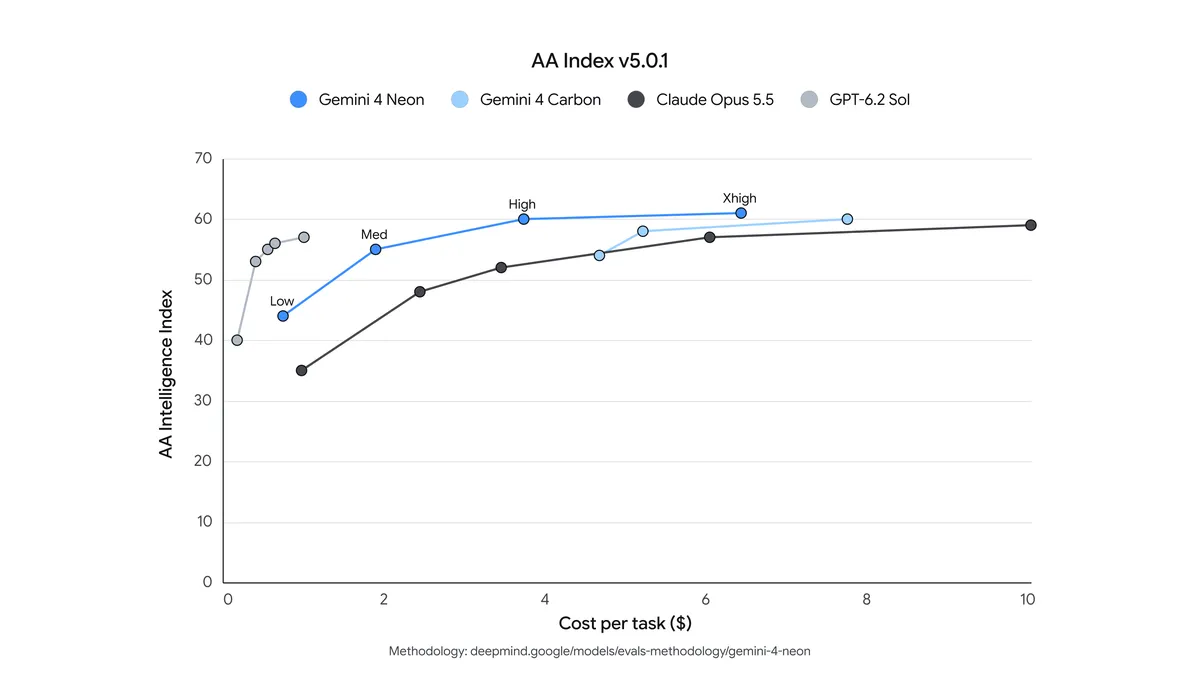
We’re refining thinking levels with each new model release to give teams finer control and a smoother progression from one tier to the next. Neon’s four levels scale steadily, letting teams dial intelligence and token spend to what each workload needs.
Neon delivers high performance at a lower cost per task across third-party benchmarks. At its default high thinking level, it pairs a high Artificial Analysis Intelligence Index score with a 32% lower cost per task than Carbon. It also sits on the Pareto frontier on both the Vals index and Agent Arena at high, with roughly 50% to 80% lower cost per task than top competing frontier models. xhigh thinking adds deeper, multi-step reasoning for the hardest engineering, analytical, and scientific workloads. Neon shows its highest intelligence score here, while still costing 36%+ less per task than competing models at their highest setting.
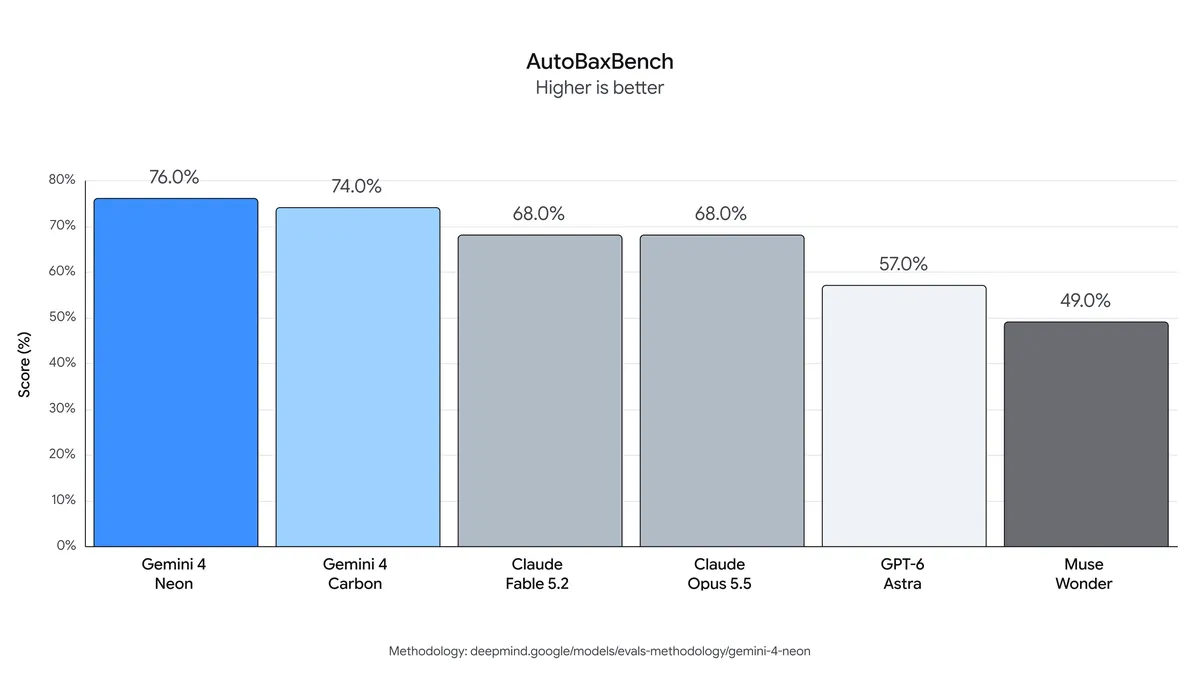
As agentic coding scales, generating secure code from the start is critical. Gemini 4 Neon for cyber produces more secure code than Carbon across all easy, medium, and hard challenges on AutoBaxBench, achieving state-of-the-art on the hard tier (76%).
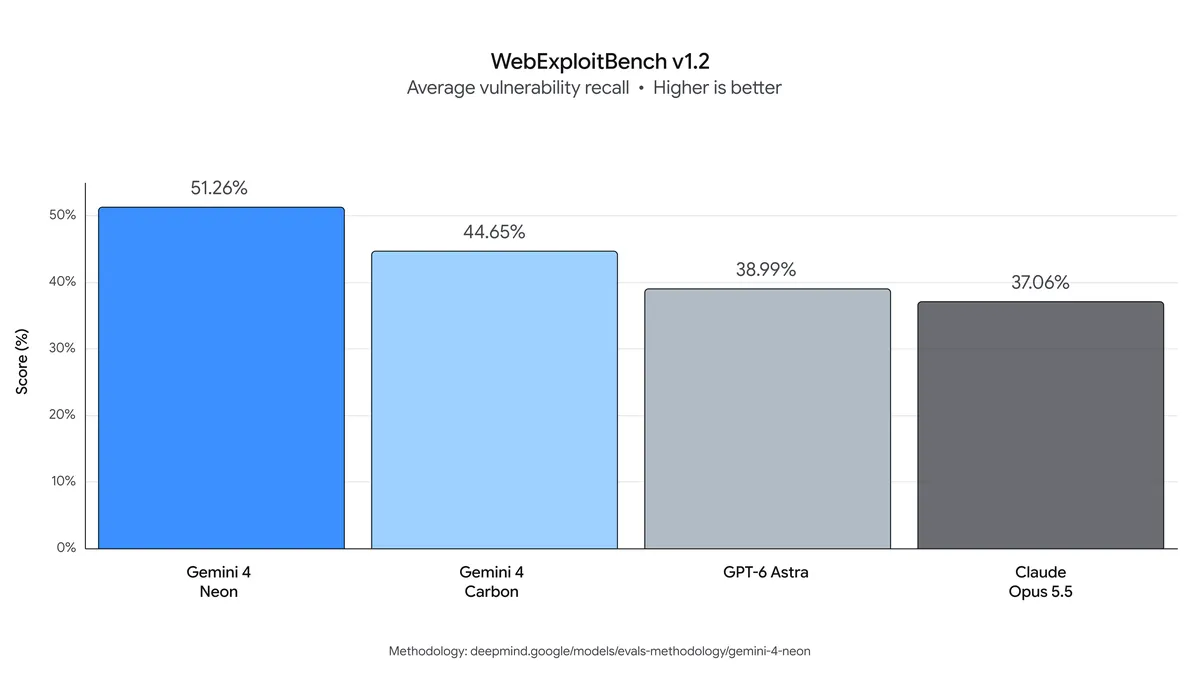
Securing systems also means proactively finding flaws before attackers do. Penetration testing has served as a cornerstone of enterprise cybersecurity. On WebExploitBench v1.2, Neon is state-of-the-art (51.26%) at half the cost of competing large models.
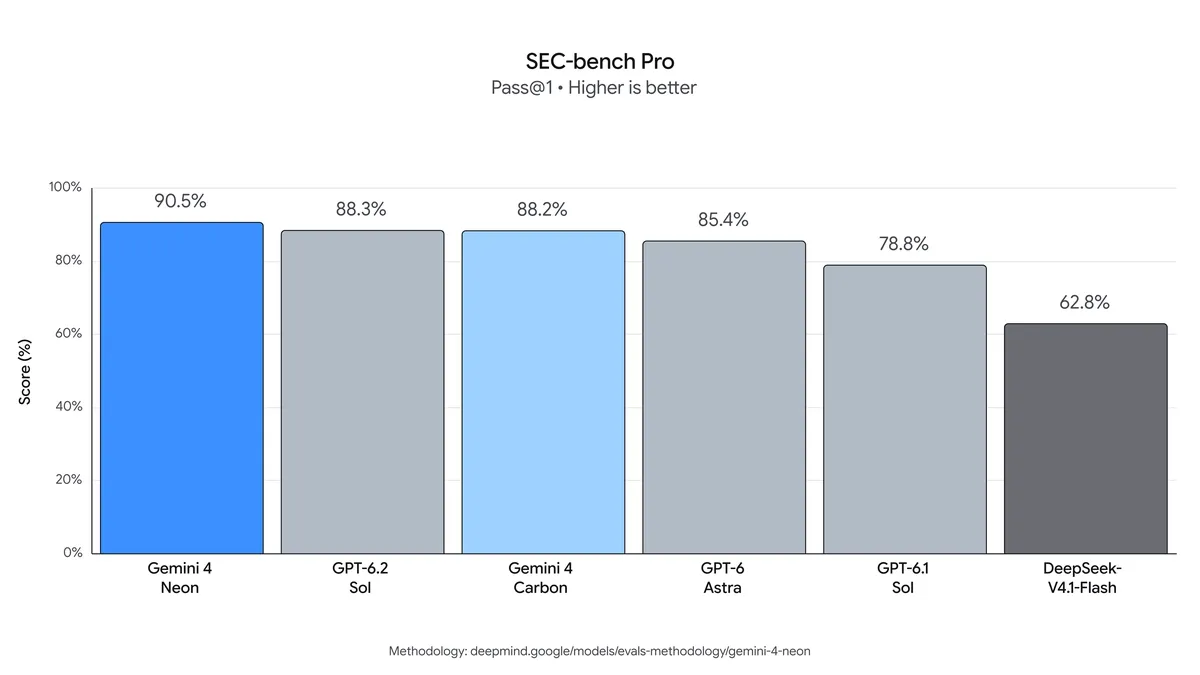
To fortify existing code, Neon for cyber delivers frontier-level performance across the code hardening lifecycle — vulnerability finding, validating, and patching — all while being faster and more cost efficient than large frontier models.