
Last year, when the novelist Laura Brooke Robson began writing Love Is an Algorithm—a love story between the cofounder of an AI dating app and a musician trying to survive in the age of large language models—she took extra care not to sound like AI herself.
She wrote sentences she doubts she would have attempted before the advent of LLMs, avoiding what she calls “wishy-washy metaphors,” and took “a more winding path to avoid an em dash or a tripartite list.”
Since the widespread adoption of LLMs, Robson says her writing has fundamentally changed for the better, becoming a deliberate inverse of what she sees as AI’s default lack of style.
“I find myself writing less mechanically,” she says. “I have this urge to make little mistakes, like winks to the reader, to show that there’s a human behind the words. Like: What if I just invented a phrase? What if I did something unexpected with my punctuation?”
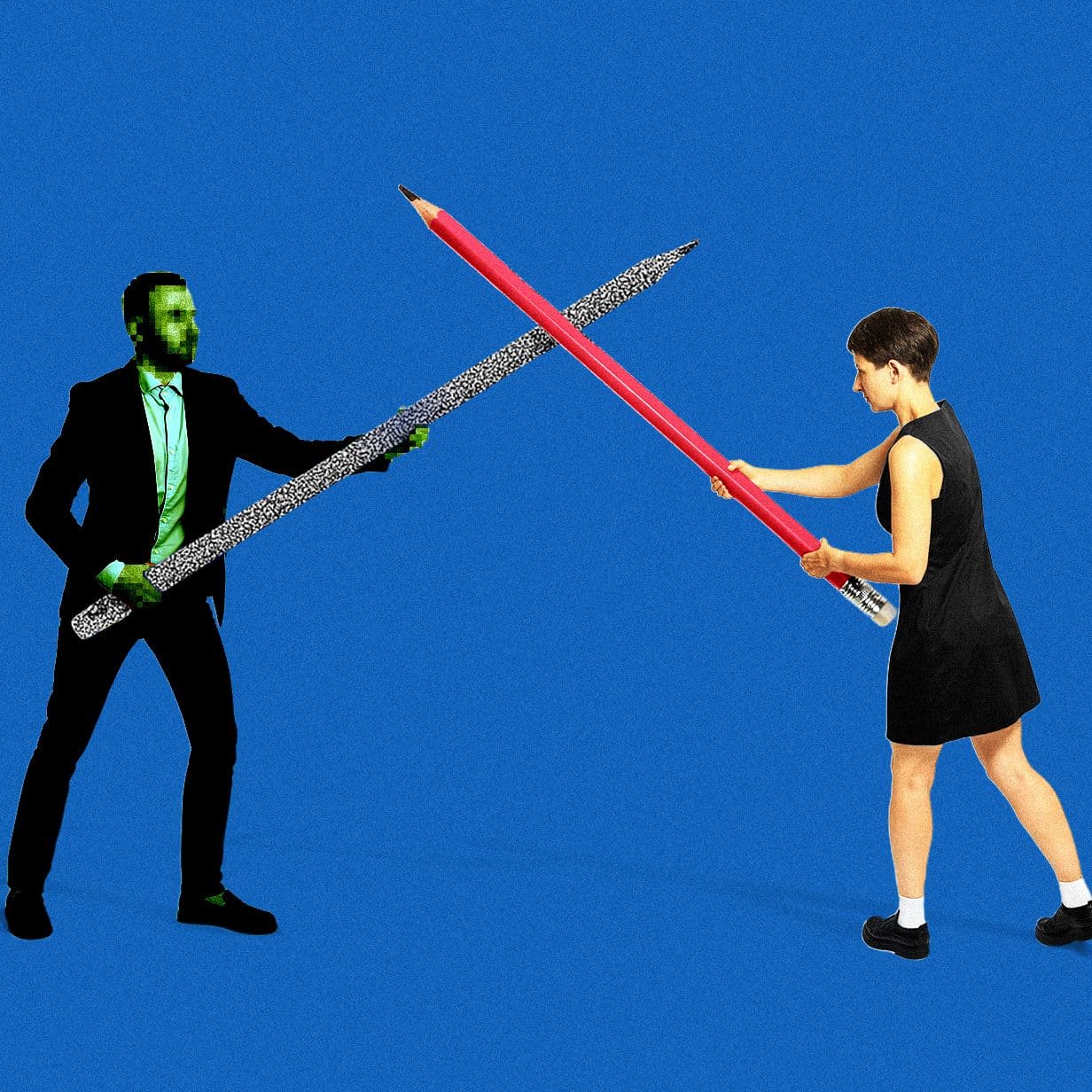
Robson is part of a larger cohort of writers who are practicing what could be called an anti-AI writing style. Across journalism, criticism, creative writing, and especially among compulsive LinkedIn posters, writers are converging on a set of choices that implicitly resist the trappings of AI-generated prose.
The style mostly takes shape through negation, often of the obvious AI tells, like lists of three, passive voice, not x but y, and em dashes. But it also prizes idiosyncrasy as its overriding principle, tapping into specific first-person anecdotes and eccentric similes that demonstrate the necessary drudgery of writing.
“I think AI could absolutely trigger a literary counterculture,” says Robson. “It seems to me that literary fiction will shift even further in the direction of the weird, the esoteric, while personalization takes hold of commercial fiction.”
Throughout the publishing world, allegations of AI have been troubling authors. In March, Hachette pulled Mia Ballard’s horror novel Shy Girl after speculation spread online that its writer had heavily utilized AI, a claim she rejected. Ballard, who says she has new writing forthcoming, has had to restrategize. “Having my writing feel more real and authentic is my number one priority,” she says, in addition to editing her own writing because she claims an editor she hired ran the book through AI software. “That is what bit me in the ass the first time.” Hachette did not immediately respond to a request for comment.
Likewise, Steven Rosenbaum’s book The Future of Truth, an examination of “how AI transforms reality,” was purported to include multiple fabricated quotations generated by AI, which Rosenbaum later admitted was true.
Ellena Savage, an Australian novelist and academic whose prose tends towards complex-compound sentences inspired by Victorian literature, says she has “sadly been victimized by thoughts of chatbots.” “AI has stolen several syntactical conventions I once held dear. I miss over-deploying the em dash. I miss the rule of three, which was so satisfying. Now what—the rule of two? Five? Seven? 10?”
Across magazines and digital publications, this anti-AI counterstyle is reshaping in-house style and editorial practice too. Richard Fisher, an honorary professor at University College London and editor at online culture magazine Aeon, says AI has prompted him to encourage writers “to be more human” and write more conversationally. “We don't want to sand out the rough edges, because AI cannot write prose as spiky or idiosyncratic as humans. Writers might not want to change their practice, but some might be forced into it.”
Mano Sundaresan became Pitchfork’s head of editorial content in July 2024, around the time LLMs became more mainstream. Coming from a blogging background, he encouraged writers “towards their own voice,” something he says, in hindsight, “could have also come from this AI turn.” He and his fellow editors have since sent writers a memo stating that no AI may be used when filing review copy, and encouraging first-person perspectives. (Pitchfork is owned by Condé Nast, which also owns WIRED.)
AI has affected the commissioning process also. When Philip Picardi, editor-in-chief of Playboy, opened the magazine’s inbox to pitches in May, he received around 1,000 submissions. After experimenting with Claude himself, he says he could tell that the majority had been generated with AI. “The key thing from that experience that became really important to us at Playboy was that we needed first-person human experience,” he says. Since then, he's encouraged more formally adventurous writing, thinking back to theorists “like Foucault, or, you know, bell hooks, who challenged language just by refusing to capitalize her name. We want that kind of writing that AI can't replicate.”
In one of the starkest outlines of this anti-AI counterstyle so far, Clickhole writer Jessye McGarry authored an article titled “5 Reasons to Love Summer (NO AI)”, which was filled with typos and incessant pleas that it was written by a human. “When summer’s here, you can finally shake off the winter blues and get out in the beaitiful sunshine!”
McGarry says the spelling mistake was “a funny, exaggerated choice. It took more work to leave it in, because I had to undo the autocorrect.”
This counterstyle has developed in gradual adjustments, and is reaching its apex on LinkedIn. It’s now very common to see on the feed instructive posts on how to avoid sounding like AI. “I always push for first-person content because I want to see the blood, sweat, and tears that went into it,” says Ray Slater Berry, founder of marketing agency dslx. He added that the agency will “always be writing in the first-person from hereon out.” Berry says he even holds monthly meetings within the company to recap AI trends and update their ever-expanding document, ensuring their human-created copy never sounds like AI.
In April, venture builder Ben Horwitz saw the real-time benefits of this anti-AI counterstyle when he built the app Sinceerly, which he dubs the “anti-Grammarly.” The tool deliberately leaves typos in emails and signs messages off with “sent from my iPhone.” When Horwitz A/B-tested standard emails against Sinceerly-generated ones by sending them to Fortune 500 CEOs, the only emails they opened were the ones with lowercase, misspelled subject lines. “People now have a thirst for something different and for a lack of uniformity,” Horwitz explains. The resulting homogeneity, he says, has made him “really appreciate good writing more.”
That renewed appreciation for good writing might be one of the unexpected benefits of the AI writing era. Last April, John Warner, a veteran writing teacher, published More Than Words: How to Think About Writing in the Age of AI, in which he argued that rather than replacing writers, AI might actually come to reinstate the value of good writing and the style and process therein. Warner had spent years trying to kill the typical five-paragraph student essay “and what I call pseudo-academic BS,” he says—the kind that ChatGPT now produces.
LLMs have introduced a new paranoia about style, and lack thereof, that might, at least in the short term, be a good thing. While it may not concern world-class writers, for B-rate writers and below, it could provide a new incentive to improve in order to avoid being made redundant by LLMs.
But as AI keeps pace with human writing, potentially being trained on a corpus of anti-AI writing styles as they develop, it could soon necessitate the invention of an anti-anti-anti-AI style. “Whatever cosmetic counterstyle is created in response to AI, AI could mimic,” says McGarry. “The only true counterstyle is good writing.”