
Orchard: An open framework for scalable agentic AI

At a glance
- Orchard is an open-source framework for scalable and cost-effective agentic AI research, built around Orchard Env, a reusable environment service for training and evaluating agents across task domains.
- The same Orchard infrastructure supports software-engineering, web-navigation, and personal-assistant agents, and can train them directly inside real deployment harnesses such as Codex, OpenClaw, and ZeroClaw—letting researchers reuse environments, data pipelines, and evaluation workflows across tasks.
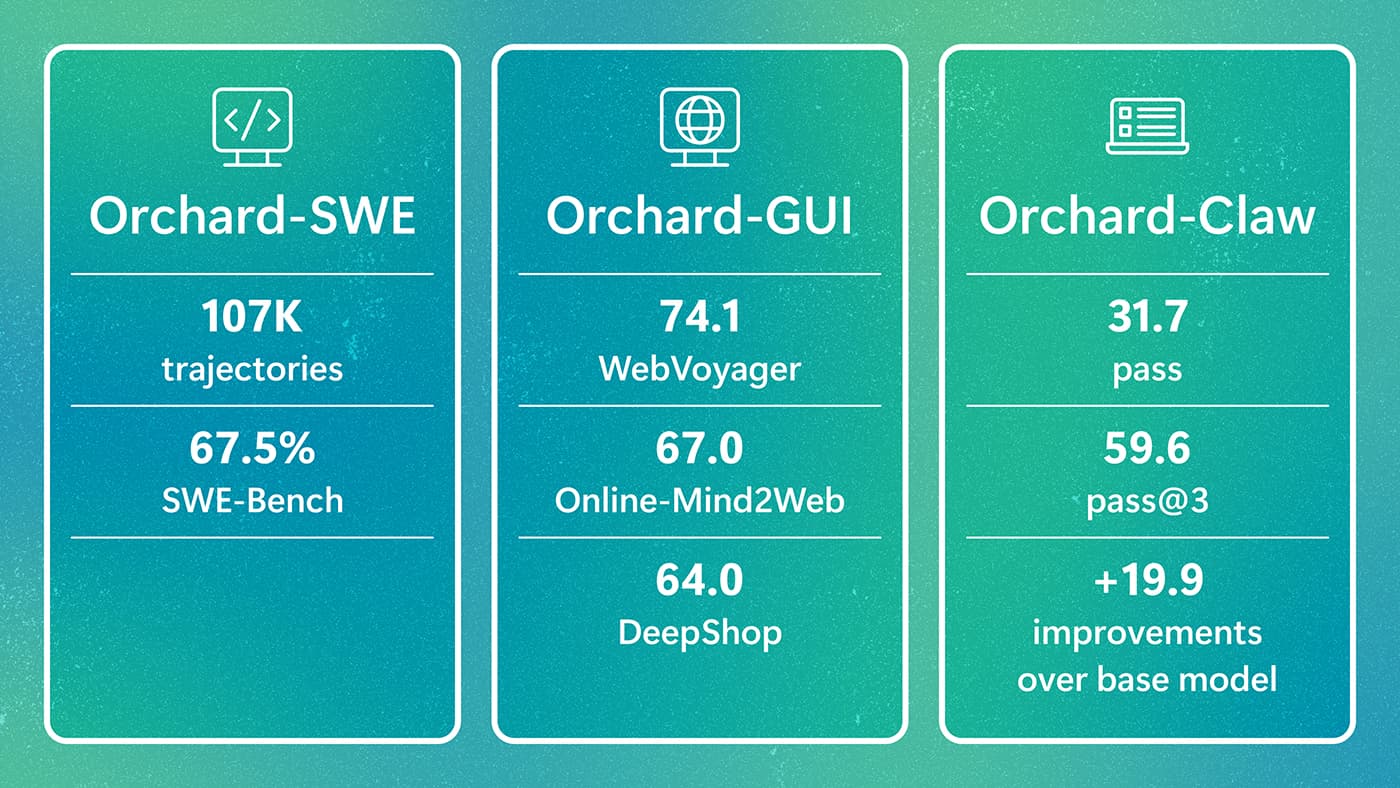
- Orchard-SWE, Orchard-GUI, and Orchard-Claw demonstrate that relatively small open-weight models can achieve strong results on complex real-world tasks. For example, Orchard-SWE reaches 69.7% on SWE-bench Verified—73.0% with value-model reranking—using only about 3 billion active parameters, approaching frontier systems using more than 10 times larger models.
Alongside the models and workflows, the project releases training data and evaluation methods intended to help the broader research community build and study open agentic systems. Artificial intelligence is rapidly moving beyond static question-answering toward autonomous agents that can plan, reason, and act across complex, multistep environments. These systems can fix bugs in complex codebases, navigate the web on a user’s behalf, and manage workflows involving calendars and email.
While there is excitement around agentic AI’s capabilities, the research community faces a persistent bottleneck. Building state-of-the-art agentic systems often requires proprietary infrastructure, including custom sandboxes, closed training pipelines, and proprietary datasets that most researchers and practitioners cannot access or reproduce.
To address this gap, we introduce Orchard (opens in new tab), an open-source framework for scalable agentic modeling. At the center of Orchard is Orchard Env, a lightweight, Kubernetes environment that provides reusable isolated components for running and building agents at scale—from collecting training data to reinforcement learning rollouts and evaluation.
Unlike many existing frameworks, Orchard Env is designed to support different agent systems and task types without modification. The same service can support software-engineering agents, web-browsing agents, and personal-assistant agents across domains.
To demonstrate this approach, we are releasing three domain-specific training recipes—Orchard-SWE, Orchard-GUI, and Orchard-Claw. (opens in new tab) We are also releasing the training data and evaluation methods used to build them.
Spotlight: Microsoft research newsletter

Microsoft Research Newsletter
Stay connected to the research community at Microsoft.
Environment layer that scales across types of tasks
The central idea behind Orchard is that the runtime environment should be a standalone, reusable service rather than infrastructure embedded inside a specific training framework. Orchard Env’s Kubernetes foundation enables it to create, manage, and remove thousands of isolated components in parallel.
The system is designed to work across tasks like coding, web browsing, using tools. It is also designed to work across different agent systems, along with stages of the training and evaluation process, including data distillation and reinforcement learning rollouts.
This flexibility makes Orchard practical at a research scale. Teams can introduce new benchmarks, agent systems, or training algorithms without rebuilding the underlying infrastructure from scratch.
Orchard also makes it possible to train agents inside any harness. Today’s most capable agents rarely run as a bare model. They operate through sophisticated harnesses—such as Claude Code, Codex, and OpenClaw—that manage multi-turn reasoning, tool use, and connections to external systems. Open training tools usually cannot handle these stateful, multi-process harnesses, forcing researchers to train on a simplified stand-in and then deploy in the real setting, which creates a mismatch. Orchard closes this gap: a lightweight proxy records the harness’s own model calls as training data while each rollout runs in its own container, so an agent can be trained end-to-end directly in the harness that it will be deployed with—OpenClaw, Codex, ZeroClaw, or others—and across several harnesses.
Orchard-SWE: Advancing open-source software engineering agents
Software engineering is one of the most demanding settings for autonomous agents. It requires multi-step reasoning over real codebases, tool use, and the ability to recover from mistakes. Orchard-SWE is our training workflow for this domain. It is built using the Mini-SWE-Agent framework, designed to autonomously solve software engineering tasks, and evaluated on the widely used SWE-bench Verified benchmark, which tests a model’s ability to navigate, diagnose, and repair real-world codebases.
To train the system, we distilled 107,000 agent interactions from two advanced open-weight models (MiniMax-M2.5 and Qwen3.5-397B) covering a broad range of GitHub Issues. The training process uses credit-assignment supervised fine-tuning: rather than discarding attempts where the agent failed to fully resolve an issue, the system learns from the productive portions of those partial attempts, expanding the amount of useful training data available to the model.
Reinforcement learning comes next, but its feedback is sparse—an agent usually learns only whether its final patch passed or failed the hidden tests. We start with Balanced Adaptive Rollout, designed to make the most of these infrequent success signals, and then add two “dense reward” techniques for richer guidance: on-policy distillation, in which a stronger teacher model scores the agent’s decisions step by step, and a process reward model, in which an AI judge rewards sound problem-solving process—writing tests that reproduce the bug, verifying the fix, and checking that existing behavior still works—independent of whether the final tests passed.
Finally, we train a value model on past rollouts to rerank candidate solutions. Reinforcement learning generates many practice trajectories that are normally discarded; instead, trajectories from 20 prior experiments train a compact 4-billion-parameter value model that recognizes high-quality solutions, and at problem-solving time it scores several candidate answers and picks the best one. Together, these techniques take Orchard-SWE from a 61.4% baseline on SWE-bench Verified to 69.1% with Balanced Adaptive Rollout and 69.7% with the dense-reward techniques—a new state of the art among open-source models of comparable size (roughly 3 billion active parameters)—rising to 73% with value-model reranking, approaching frontier systems more than 10 times larger, as shown in Figure 1.
Orchard-GUI: A lightweight browser agent for real-world web tasks
Web navigation presents a different set of challenges. Agents must interpret visual layouts, interact with dynamic interfaces, and complete open-ended tasks described only in natural language.
Orchard-GUI trains a 4-billion-parameter vision-language model as a browser agent using a relatively small amount of supervision: 400 distilled demonstrations combined with 2,200 open-ended training tasks. Despite this limited training data, the resulting model achieves strong results across several web-navigation benchmarks: 74.1% on WebVoyager, 67.0% on Online-Mind2Web, and 64.0% on DeepShop, for an average of 68.4%, as shown in Figure 1.

These results place Orchard-GUI among the strongest open-source web agents to date while remaining competitive with larger proprietary models. The results also suggest that with the right training approach and environment, small open models can perform well on real-world web tasks.
Orchard-Claw: Personal assistant agents for everyday productivity
Many of the most impactful agentic applications involve everyday productivity tasks, including reading and drafting emails, managing calendars, searching for information, and coordinating across tools. Orchard-Claw focuses on personal-assistant tasks by training an agent on just 200 synthetic tasks. Evaluated on Claw-Eval, a benchmark covering realistic productivity workflows, it successfully completes 59.6% of tasks when given up to three attempts. That increases to 73.9% when paired with the stronger ZeroClaw agent system.
Because Orchard can train agents directly inside real deployment harnesses, Orchard-Claw is trained across several of them—including ReACT, ZeroClaw, OpenClaw, and Codex—rather than a single simplified loop. Training inside these real harnesses substantially improves the agent’s reliability; under the Codex harness, for example, its success rate rises from 18.6% for the untrained model to 51.5% after Orchard training.

Implications and the road ahead
Orchard’s results reinforce a broader point: the environment layer matters. By making the underlying infrastructure open, lightweight, and reusable, Orchard lowers the cost of agentic AI research. Teams no longer need to build custom isolated environments from scratch or depend on proprietary cloud services. The same Orchard Env can be used to generate training data, run reinforcement learning rollouts, and evaluate final models without rebuilding the system each time.
Looking ahead, we see reusing training experience as a promising direction toward cumulative agent learning. Instead of discarding trajectories once a training run finishes, we treat them as persistent assets—for example, distilling them into reusable value models. This enables agentic experience to accumulate over time, allowing each new generation of agents to inherit and extend the knowledge acquired by previous ones, rather than starting from scratch.
The data efficiency demonstrated by Orchard-GUI suggests that larger-scale web agents could be trained without requiring large amounts of manually created training data. By releasing the complete Orchard stack, including the environment service, training pipelines, and training datasets, we hope to help the broader research community build more capable open agents more quickly.
Acknowledgements
We thank the teams at Microsoft Research and collaborating institutions for their contributions to Orchard, as well as the open-source community whose benchmarks and tools made this research possible.
Opens in a new tabThe post Orchard: An open framework for scalable agentic AI appeared first on Microsoft Research.
Read the full original article:
Microsoft Research Blog