What 24/7 actually costs: the operational anatomy of round-the-clock support for mid-market retailers
Sponsor content is created on behalf of and in collaboration with Bazoom by DigitalCommerce360. Our editorial staff is not involved in the creation of the sponsored content.
Round-the-clock support looks like a simple hiring problem: three shifts instead of one, so roughly triple the payroll. In practice, mid-market retailers often discover that the real costs show up later in night-shift premiums, attrition-driven hiring and training, and supervision hours that rarely make it into the initial budget.
That is why proposals for seemingly identical 24/7 support often vary so widely. The difference usually boils down to how each ecommerce BPO provider structures coverage: which time zones handle which hours, who supervises the overnight queue, and whether quality controls remain active when headquarters goes home.
In the following paragraphs, we break down the main cost drivers behind 24/7 support as well as the questions retailers should ask before signing a contract.
With the intro out of the way, let’s get started.
Why the three-shift math understates the cost
A 24/7 support desk costs more than three times an eight-hour operation. Overnight coverage comes with wage premiums, higher attrition, dedicated supervision, and minimum staffing requirements that force you to pay for capacity your overnight ticket volume may never fully use.
Start with staffing. A queue that averages four tickets per hour overnight still needs at least two agents on the clock. A single agent leaves you exposed to breaks, sick days, and simultaneous escalations. In other words, you are paying for resilience, not just workload, and overnight demand rarely fills that capacity.
Wage law adds another layer. In the Philippines, the world’s largest offshore support market, Article 86 of the Labor Code mandates a night-shift differential of at least 10% of an employee’s regular wage for every hour worked between 10 p.m. and 6 a.m. Competitive employers often pay above that minimum to retain experienced overnight staff. Similar premiums, whether statutory or market-driven, exist across most support delivery locations.
Growing ecommerce demand is pushing more retailers to confront these costs. US ecommerce sales grew nearly 10% year over year in Q1 2026, and every point of growth brings more customer support activity outside traditional business hours: order-tracking requests at midnight, chargeback disputes on weekends, or checkout failures during a flash sale in another region.
How follow-the-sun staffing works
Follow-the-sun staffing transfers support coverage between teams in two or three time zones so agents can work local daytime hours. The model eliminates night-shift premiums and reduces the fatigue associated with overnight work, but it introduces costs of its own in the form of handoffs, overlap hours, and additional sites to manage.
A common setup for a US retailer combines a nearshore team in Mexico covering US business hours with an offshore team in the Philippines or Eastern Europe whose local daytime aligns with the US night. Each team operates during normal working hours, which often improves retention and reduces the risk of errors associated with overnight shifts.
The costs do not disappear; they move elsewhere. Every handoff creates an opportunity for information to be lost, so mature programs invest in 30 to 60 minutes of shift overlap, shared ticketing systems with detailed case notes, and structured handoff processes where open escalations are reviewed live rather than passed along asynchronously.
Multiple sites also mean multiple recruiting pipelines, training schedules, and management teams. At lower overnight volumes, a single site running a compensated night shift is often less expensive than maintaining a second location. As overnight demand grows, however, follow-the-sun staffing often becomes the stronger option on both cost and quality.
Onshore, nearshore, and offshore: how geography shapes cost and coverage
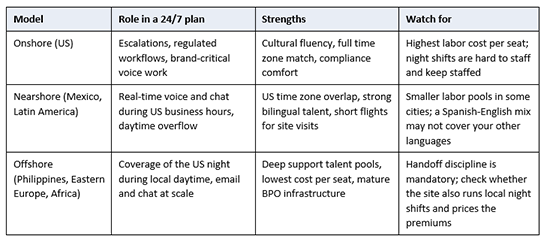
Most mid-market 24/7 support programs combine multiple delivery locations rather than relying on a single geography. Onshore teams often handle regulated workflows and brand-sensitive interactions, nearshore teams provide real-time coverage during US business hours, and offshore teams deliver scalable support while covering overnight demand during their local daytime. The mix of locations, more than any single hourly rate, often determines the total cost of a program.
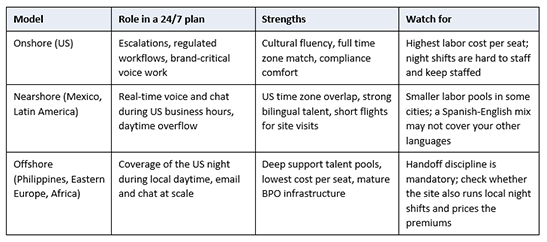
When reviewing a proposal, map every hour of your support schedule to a delivery location and local time zone. If a provider covers your 2 a.m. support volume from a site where it is also 2 a.m. locally, you are still paying for a night-shift operation, along with the premiums, turnover, and supervision costs that typically accompany it.
Maintaining quality across every shift
Quality in a 24/7 support operation depends on controls that remain active around the clock. That includes QA reviews across every shift, cross-site calibration, clearly defined escalation ownership, and a shared knowledge base that all teams follow. Programs that concentrate quality management within headquarters business hours often see performance drift between locations and shifts.
When evaluating a provider, ask four questions:
- Does QA review interactions from every shift and every location, or only from the hours reviewers work?
- Do QA teams across locations calibrate against the same standards, ensuring scores are applied consistently?
- Who owns an escalation opened overnight, and how quickly is it reviewed by someone with decision-making authority?
- Does every site work from the same knowledge base, or do local versions gradually diverge?
AI-powered QA is changing the economics of quality management. Instead of reviewing a small sample of interactions, automated scoring can evaluate every conversation for accuracy, tone, and compliance. That visibility is especially valuable during overnight and low-supervision hours.
Large distributed operations can maintain consistent quality when these controls are in place. Helpware, for example, provides round-the-clock support in more than 45 languages across 19 delivery locations on four continents while maintaining a 90% CSAT score. The company also reports average client partnerships exceeding five years, suggesting quality standards remain consistent well beyond the initial onboarding period.
Cost components buyers often overlook
Before comparing bottom-line rates, make sure each proposal includes the same cost components. Differences often appear not in the headline rate, but in what is and is not included behind it.
- Night and holiday premiums: Statutory wage differentials, holiday multipliers, and any market-driven premiums at each delivery site, whether built into the rate or charged separately.
- Staffing floors and shrinkage: Minimum staffing levels per shift, plus allowances for breaks, training, meetings, and unplanned absences.
- Shift supervision: Team-lead and management coverage applied across all 168 hours of the week, including overnight periods.
- Overlap hours: Paid handoff windows between locations, typically 30 to 60 minutes per shift transition.
- Technology costs: Ticketing, telephony, QA, workforce management, and other software licenses allocated across every scheduled agent.
- Attrition and backfill: Recruiting, onboarding, and training costs required to maintain staffing levels, particularly in operations with overnight or holiday coverage.
- Business continuity: Redundant power, internet connectivity, and backup delivery capacity capable of absorbing volume if a site becomes unavailable.
Key takeaways
The cost of 24/7 support is driven more by operating model than headcount. Overnight coverage introduces wage premiums, higher turnover, additional supervision, and minimum staffing requirements that increase costs beyond the simple three-shifts-equals-three-times-the-payroll calculation.
Follow-the-sun staffing replaces many of those overnight costs with handoffs, overlap hours, and multi-site management. As overnight volume grows, the model often becomes more cost-effective and easier to scale.
The geographic mix behind a proposal matters as much as the quoted rate. Onshore, nearshore, and offshore locations each solve different coverage challenges and contribute differently to overall cost
Consistent quality depends on controls that operate across every shift, including QA reviews, calibration processes, escalation management, and shared knowledge resources.
Before signing a contract, ask providers to map coverage by location and local time zone and explain exactly which premiums, staffing assumptions, and operational costs are included in the quoted rate.
Frequently asked questions
Is 24/7 support worth it for a mid-market retailer?
It depends on when customer demand occurs. Review at least 90 days of ticket, order, and contact data. If a significant share of orders, cart-abandonment issues, payment problems, or customer inquiries occurs outside business hours, delayed responses may be affecting revenue, customer satisfaction, and chargeback rates. If overnight demand remains low, a well-designed asynchronous support model combined with strong self-service resources may be more cost-effective than maintaining live overnight coverage.
Which is cheaper, a night shift at one site or follow-the-sun?
At lower overnight volumes, a single location with dedicated night-shift coverage is often the less expensive option because it avoids the management and infrastructure costs of multiple sites. As overnight volume increases, however, wage premiums, turnover, and quality-management challenges become more significant. At that point, a follow-the-sun model often delivers lower long-term costs and more consistent service quality.
How many agents does a minimal 24/7 desk need?
Most 24/7 operations need at least two agents on duty at all times to maintain basic coverage and redundancy. Since 24/7 support covers all 168 hours in a week (24 hours × 7 days), staffing requirements add up quickly. Once breaks, training, absenteeism, and supervision are factored in, even a low-volume operation typically requires approximately nine to twelve full-time equivalents before workload-based staffing is considered. This is one reason small 24/7 teams often have a higher cost per ticket than daytime-only operations.
The post What 24/7 actually costs: the operational anatomy of round-the-clock support for mid-market retailers appeared first on Digital Commerce 360.
Read the full original article:
Digital Commerce 360